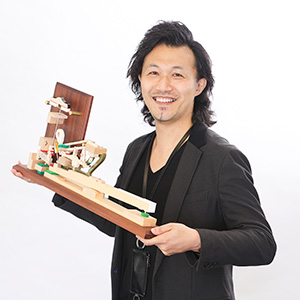
Shinichi Furuya
Tokyo / Kyoto
Erazo Hidalgo, Andrea and Pearson, Lisa and Oku, Takanori and Kimoto, Yudai and Furuya, Shinichi and Herrojo Ruiz, Maria
Performance anxiety (PA) is common in high-stakes settings, from public speaking to the performing arts, yet its mechanisms remain poorly understood. Using behavioural analysis, computational modelling, and electroencephalography, we examine whether PA is associated with differences in learning from reward and punishment under varying task uncertainty. Across three experiments with 95 pianists, participants adjusted melody dynamics to match an unknown dynamics target using graded reward or punishment feedback. Bayesian hierarchical regression shows that increasing PA levels are associated with faster reward learning under high uncertainty (large action space) but faster punishment learning under low uncertainty (reduced action space). These learning biases---reflecting the interaction between PA and reinforcement type---are associated with reinforcement-driven modulation of motor variability and frontal theta (4--7 Hz) activity encoding feedback changes and signalling motor adjustments. The findings associate predisposition to PA with differences in reward- and punishment-based learning that depend on task uncertainty.
Tokyo / Kyoto