PRESS RELEASE

Sony Computer Science Laboratories, Inc.
3-14-13, Higashigotanda, Shinagawa-ku,Tokyo
141-0022 Japan
January 23, 2026
Sony Computer Science Laboratories Develops
Third Project for the
Tomonami Creativity Acceleration Support System
~ Exhibits works at Kengo Kuma Exhibition ~
Tokyo, Japan – Sony Computer Science Laboratories, Inc. (hereinafter “Sony CSL”) (President & CEO: Hiroaki Kitano) has developed Tomonami for KKAA, a system that collaborates with architectural firm Kengo Kuma and Associates (KKAA). This is the third project under Sony CSL’s initiative for Tomonami, a system that accelerates creativity for a diversity of creators, artists, and other expressive persons. Kengo Kuma’s one-man exhibit, which will display works created using Tomonami for KKAA, will be held from January 24 at the New Art Museum Singapore.
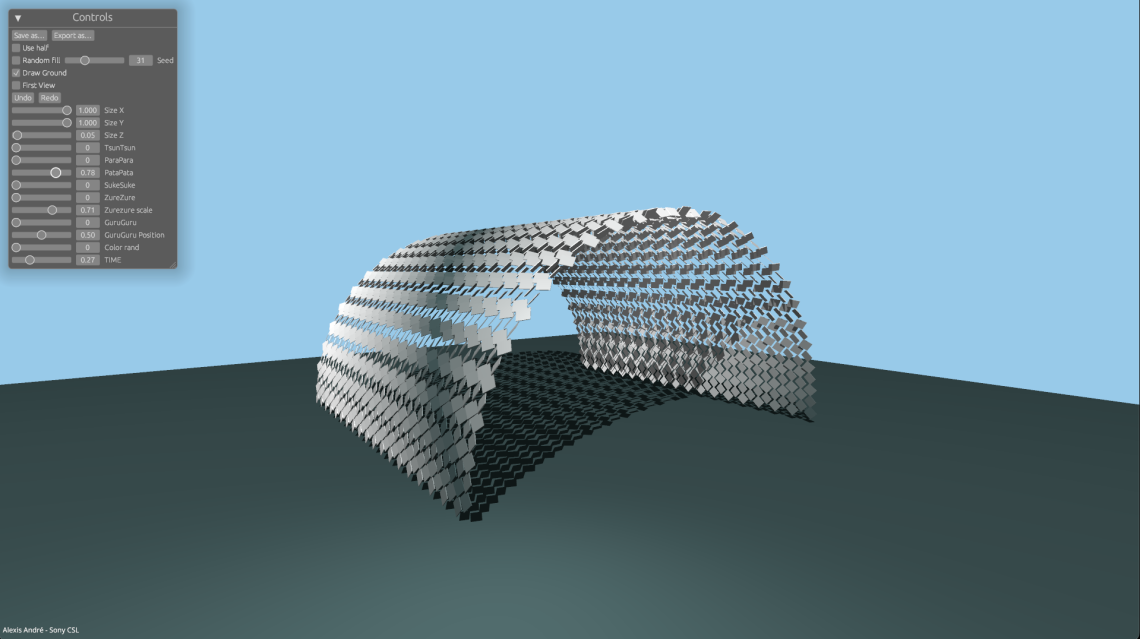
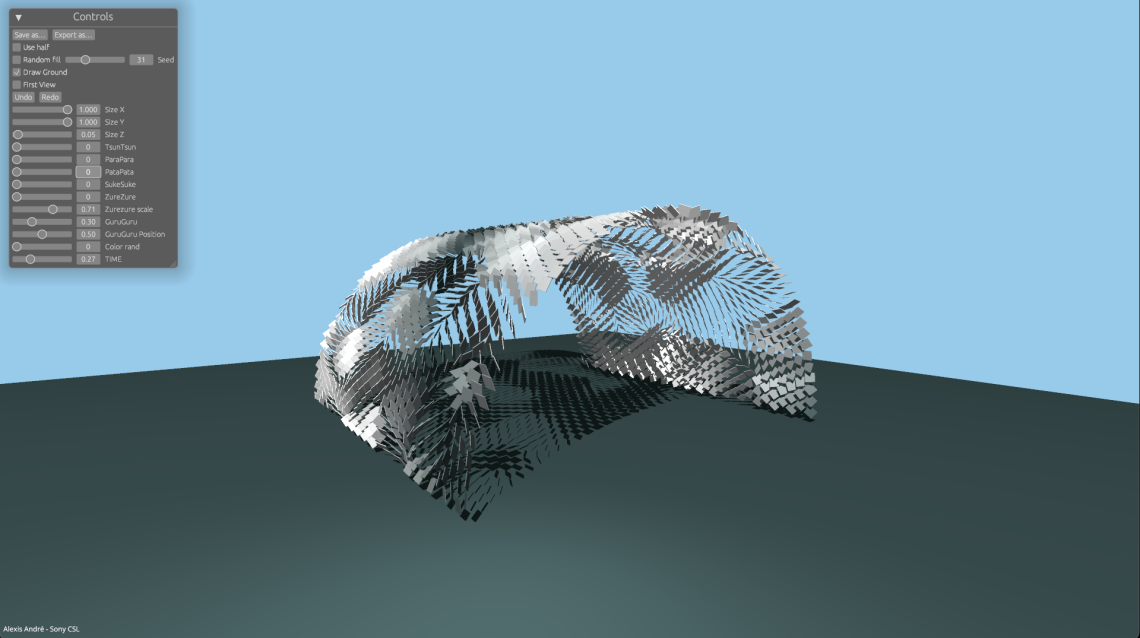
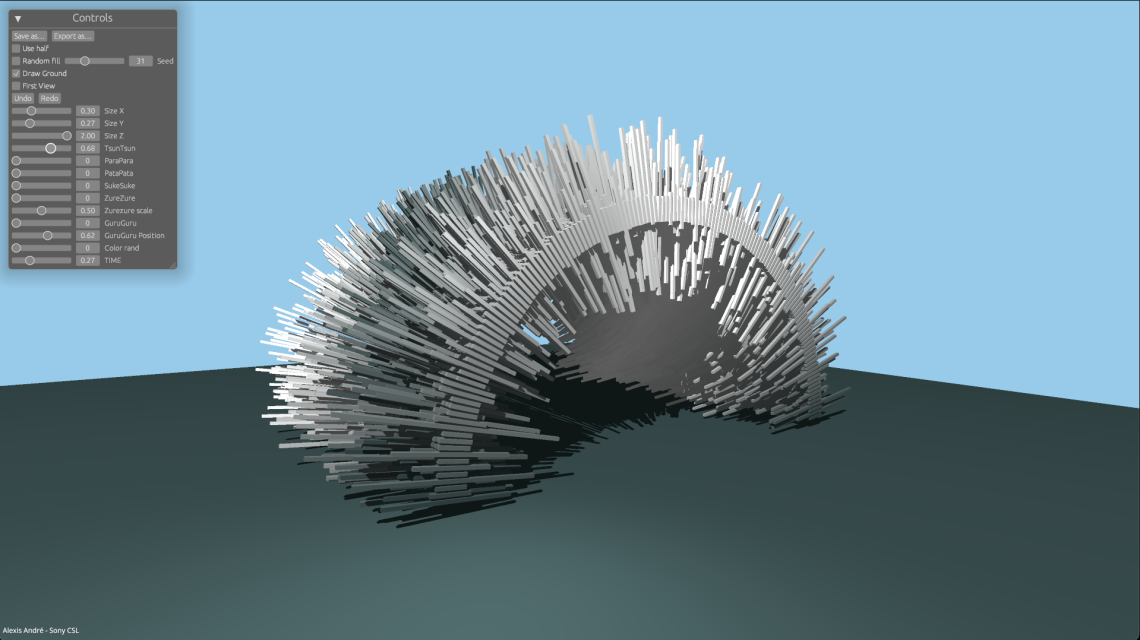
The Tomonami operating screen
The sliders at upper left have Japanese onomatopoeic terms like ParaPara (a rhythmic porosity), TsunTsun (an outward thrust of elements), and SukeSuke (a perceptual transparency through layering) as parameters. Adjusting a slider modifies its parameter (in this case, changing the behavior of particles arranged in a dome shape), making it possible to display an intuitive design intent in the form of a shareable visual representation.
Tomonami was conceived by researcher Alexis André from his work on creativity acceleration. So far, he has built unique systems that provide value while supporting the creative process while working closely with ceramic artist Yukio Yoshita and yuzen artist Ken Yotsui. This third project focused on dialogue among multiple creators in an attempt to accelerate creativity in a new field: architecture.
At KKAA, the architects use Japanese onomatopoeic expressions for particle size, flow, texture, and other architectural elements from the initial design stage, and share them among themselves to create works.
With Tomonami for KKAA, Alexis André incorporated this onomatopoeia as parameters into the user interface of his original framework , which provides KKAA’s architects with an exploratory space for creativity.
In developing the design, the architects explore this space by manipulating the parameters. By using Tomonami, the architects can generate ideas in a short period of time while repeating the process of exploring options autonomously and then using their artistic sensibilities and taste to determine whether or not to adopt them. This process that accelerates the cycle of trial and error in the creative process is the core of Tomonami, leading to new creations that the creators themselves could not have imagined.
Tomonami for KKAA also supports dialogue that draws out the diversity of creativity unique to a group of architects by converting design intentions into a shareable visual format the intentions of a design, which often are intuitive and ambiguous in conventional communication.
The name “Tomonami” combines the Japanese words “tomo” (friend) and “nami” (wave) and includes co-creation in its meaning. It expresses the artist using the technology and Alexis André understanding each other in close proximity like friends, thereby charting a new future where research and art combine to form a wave.
「KENGO KUMA: MAKERU Architecture — The Ecology of Rhythm and Particle —」
Exhibition period : From January 24th until June 14th
Venue : New Art Museum Singapore, 39 Keppel Road, #05-03/06, Tanjong Pagar Distripark, Singapore 089065
URL : https://www.newartmuseumsingapore.com/current-exhibition
Remarks by Kengo Kuma
“At KKAA, our design process often develops through onomatopoeic expressions such as “Para Para” (a rhythmic porosity) or “Tsun Tsun” (an outward thrust of elements), which open up an intuitive dialogue between humans and materials. These vocal inspired expressions draw architecture closer to human lives, cultivating a more immediate and tactile sense of space.
For our first exhibition in Singapore, we set out to explore onomatopoeia as a form of primitive linguistic expression deeply rooted in the somatic sensibilities characteristic of Asian culture.
Tomonami for KKAA is an interactive platform that allows users to experience, in real time, how space dynamically transforms through onomatopoeic input, deepening the dialogue between material and form. Through this exhibition, we hope to explore the new creative possibilities that emerge from more enriched modes of communication, together with our visitors. ”
About Kengo Kuma
Kengo Kuma was born in 1954. He established Kengo Kuma & Associates in 1990. He is currently a University Professor and Professor Emeritus at the University of Tokyo and a member of the Japan Art Academy after teaching at Keio University and the University of Tokyo. KKAA projects are currently underway in more than 50 countries. Kengo Kuma proposes architecture that opens up new relationships between nature, technology, and human beings. His major publications include Kengo Kuma Onomatopoeia Architecture Grounding (X-Knowledge), Nihon no Kenchiku (Architecture of Japan, Iwanami Shoten), Zen Shigoto (Kengo Kuma – the complete works, Daiwa Shobo), Ten Sen Men (Point Line Plane, Iwanami Shoten), Makeru Kenchiku (Architecture of Defeat, Iwanami Shoten), Shizen na Kenchiku (Natural Architecture, Iwanami Shinsho), Chii-sana Kenchiku (Small Architecture, Iwanami Shinsho) and many others.
Remarks by Alexis André
“The aim of this third Tomonami project is to visualize the creativity generated by group dialogue and expand the very process of thought and creation in architecture. I feel like this is a very significant undertaking, as we are seeing how introducing Tomonami into KKAA’s creative process can bring about changes in conventional architecture. Through Tomonami, I want to support new ideas created through the intersection of various perspectives and further pioneer the future of creation.”
About Alexis André
Alexis André has been a Sony CSL Researcher since 2009. By applying the latest digital media, he explores heretofore nonexistent creative activities, and is himself an active generative artist. His work has been shown at the Yamaguchi Center for Arts and Media (YCAM) and in the US at SIGGRAPH, a special interest group of the Association for Computing Machinery (ACM), and he has been working with various artists, from Open Reel Ensemble to the Issey Miyake-produced Aomori University Men’s Rhythmic Gymnastics team. He also invented Sony’s interactive toy platform, toio. He is currently working at Sony CSL – Paris.
[Media inquiries]
Sony Computer Science Laboratories, Inc.
csl-pr@csl.sony.co.jp