PRESS RELEASE

Sony Computer Science Laboratories, Inc.
3-14-13, Higashigotanda, Shinagawa-ku,Tokyo
141-0022 Japan
August 25, 2026
Sony Computer Science Laboratories Develops
Origami-Inspired Surgical Robot and Achieves Subretinal Injection in an Animal Model
Demonstrating high maneuverability and operability
for potential ophthalmic surgical applications
Tokyo, Japan — Sony Computer Science Laboratories President: Hiroaki Kitano; (hereinafter “Sony CSL”) has developed Origanoid, a compact surgical robotic manipulator inspired by origami structures, through collaborative research with VCCT Inc. (President: Masayo Takahashi)
Using Origanoid, the research team performed subretinal injections in an animal model, confirming fluid delivery into the subretinal space with a high success rate. The result demonstrates the potential of robotic technology that combines the precise maneuverability required for delicate ophthalmic surgery with the safety and usability necessary in real-world clinical settings.
This work was conducted jointly by Hiroyuki Suzuki, a researcher at Sony CSL, and researchers from VVCCT Inc., and has been published in npj Robotics, an international scientific journal published from Nature Portfolio.
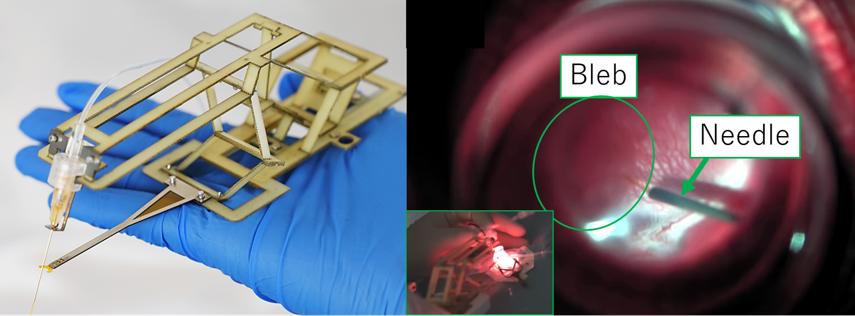
©VCCT Inc. / Sony CSL
Origanoid (left), a compact surgical robot manipulator inspired by origami structures, and subretinal injection in an animal model (right).
Precise needle-tip manipulation achieved fluid delivery into the subretinal space, confirmed by the formation of a small bleb, a localized retinal elevation caused by fluid injection.
Deatails of the Research
Origanoid is a compact, lightweight surgical robotic manipulator measuring 160 × 50 × 50 mm and weighing 17.9 g. Despite its compact size, this manipulator achieves a positioning precision of 12 μm and a maximum output force of 550 mN, providing the precise manipulation required for subretinal injection. This output force covers the manipulation forces required for many vitreoretinal surgical procedures.
This robot features a cleanly separable design in which a sterilizable arm unit is physically separated from a reusable drive unit and connected via magnetic coupling. This design combines precise maneuverability with practical usability in surgical settings. In addition, the proposed robotic system incorporates a safety mechanism that automatically retracts the surgical needle to a safe position within approximately 50 milliseconds, either in the event of power loss or upon initiation by the surgeon in an emergency.
Furthermore, the arm unit is designed to be compatible with plastic-based fabrication, which could reduce manufacturing costs, and enable future development as a single-use disposable device that does not require re-sterilization.
Performance evaluations using an eye model confirmed that a complete sequence of surgical tasks—including instrument attachment, insertion, manipulation, and withdrawal—could be performed stably.
The researchers also conducted subretinal injections in a rabbit model. Fluid delivery into the subretinal space was confirmed in five of six eyes, suggesting g the robot’s potential to support delicate surgical manipulation under conditions that closely resemble an actual surgical environment.
Background of the Research
Delicate surgical procedures in fields such as ophthalmology and neurosurgery require extremely high-precision manipulation. However, such precision is difficult to achieve with the human hand alone because of physiological hand tremor. Surgical robotic systems have therefore been under development to support these tasks by providing stable and precise movements.
Among these surgical procedures, subretinal injection is a particularly demanding technique for delivering therapeutic agents or cells beneath the retina, a fragile tissue approximately 200–300 μm thick. This procedure requires precise control of surgical instruments at the scale of tens of micrometers.
While conventional surgical robots can achieve high-precision manipulation, many rely on complex metallic structures that increase their size and weight. As a result, deployment in space-constrained operating rooms and confined surgical fields remains challenging. In addition, clinical requirements such as sterilization compatibility and safety mechanisms create additional constraints on further simplification and miniaturization.
To address these challenges, origami-inspired manipulators have attracted attention as a promising approach to achieve compact, lightweight, and easily assembled robotic systems.
This research demonstrated the potential of an origami-inspired compact robot to combine the maneuverability and safety required for delicate surgical procedures with the usability needed for practical surgical use.
Subretinal injection is an important technique for emerging therapeutic approaches, including cell therapies using iPSC-derived cells and gene therapies. The technology developed in this study is expected to support the reliable delivery of these treatments and help improve procedural safety.
In addition, compact manipulators with simplified structures may reduce the burden of implementation and operation in clinical settings, potentially facilitating the use of technologies that assist delicate and precise surgical procedures.
At the same time, further validation will be required before clinical application. Future work will focus on evaluating reliability and durability and validating the system under a wider range of surgical conditions to advance toward clinical use.
Publication
Title : Origami-inspired manipulator enables in vivo subretinal injection
Journal : npj Robotics
Authors :Hiroyuki Suzuki1, Yuki Nakano2,3, Yuki Koyama4, Tadao Maeda3 & Masayo Takahashi3
1Sony Computer Science Laboratories Inc., Tokyo, Japan
2Department of Ophthalmology, Kagawa University Faculty of Medicine, Kagawa, Japan
3VC Cell Therapy, Inc., Kobe, Japan
4Department of Mechanical Engineering, The University of Tokyo, Tokyo, Japan
DOI : https://doi.org/10.1038/s44182-026-00096-x
[Media inquiries]
Sony Computer Science Laboratories, Inc.
csl-pr@csl.sony.co.jp