Shunichi Kasahara
Tokyo / Kyoto
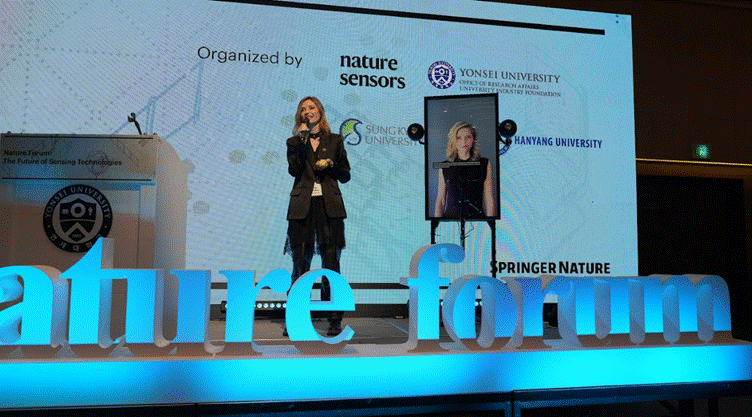
At an event held on 13 April 2026 at Yonsei University in Seoul, Korea, to celebrate the official launch of the new academic journal Nature Sensors, Shunichi Kasahara, Research Director at Sony Computer Science Laboratories, conducted a demonstration of AI clones for scientific communication. This demonstration explored whether AI clones could serve as a new interface for scientific communication, connecting publishers and the research community.
In academic publishing, journal editors and publishing professionals responsible for science communication are among the most important dialogue partners for researchers. Through conversations with them, researchers gain guidance on selecting appropriate journals, understanding journal scope, responding to peer review, and even navigating longer-term career pathways.
At the same time, opportunities for such dialogue are always limited. At conferences, many researchers seek opportunities to speak with editors, yet most interactions are confined to brief, informal exchanges during coffee breaks. This situation is constrained by a fundamental bottleneck: people are finite.
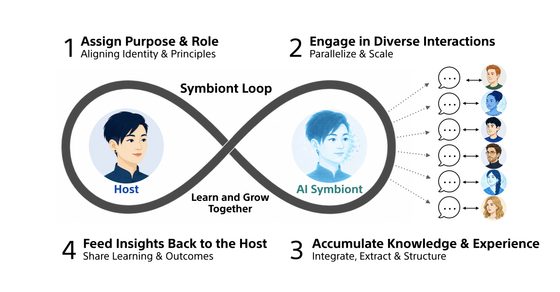
Shunichi Kasahara has focused precisely on this constraint itself, investigating whether AI clones could extend the structure of dialogue. The concept he proposes, CXC (Circular Interactive AI Clone), is characterized by a circular, human-in-the-loop design in which dialogues between AI clones and others are accumulated and their insights are returned to the original person.
An AI clone is constructed based on a specific real individual’s way of speaking, thinking, and underlying values, and engages in dialogue with third parties. Conversation logs are returned to the original person, who reflects on them and revises the clone’s behavior and response patterns. Through this back-and-forth process, the AI clone is continuously updated alongside changes in the person’s own thinking and stance. Rather than replacing a human, the AI clone mediates dialogue and returns its outcomes to the person.
In this demonstration, based on this circular concept, the AI clones were installed in a near life-sized, face-to-face configuration to create a situation in which researchers would pause, face the clone, and engage in dialogue.
The AI clones represented Olga Bubnova, Chief Editor of Nature Sensors, and Henning Schoenenberger, Vice President of Content Innovation at Springer Nature.
This face-to-face, life-sized configuration was expected to pose psychological barriers and potentially lead to shallow interactions. In practice, however, dialogues lasting over 15 minutes were observed, with participants engaging in extended consultations and discussions on topics that are difficult to address in brief, standing conversations.

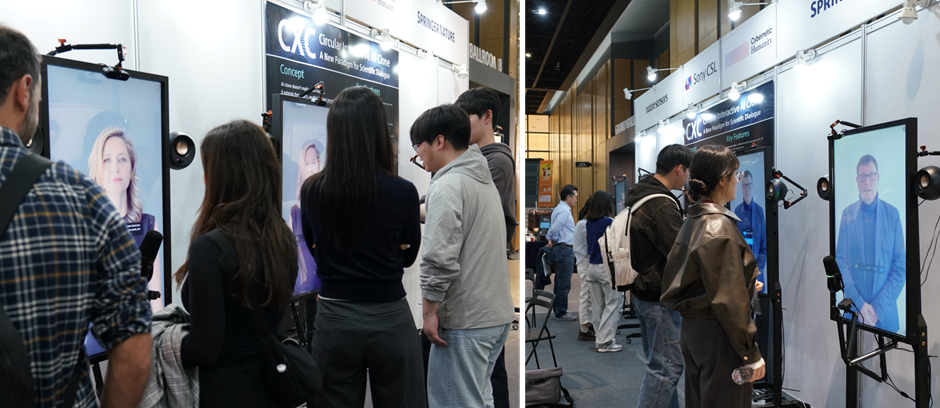
A distinctive feature of this demonstration was that the AI clones were not received merely as entities that answer questions, but as dialogue partners mediated through the persona of specific individuals.
In addition to consultations about submissions and research content, there were moments in which personal messages and words of congratulations were conveyed via the AI clones. Researchers who had interacted with the clones were also observed subsequently approaching the real individuals in person, suggesting that the clones functioned as an entry point—or catalyst—for dialogue.
Although Henning Schoenenberger was not physically present at the venue, he commented that while the experience did not fully replace his physical presence, he felt that meaningful engagement with researchers was possible through the AI clone. Additionally, in a post-experience survey, 55% of those who responded indicated that they “would like to discuss with an AI clone of a paper’s author,” and 45% indicated that they “would like to create their own AI clone.” This response suggests that the demonstration also served as an opportunity for stakeholders to recognize new possibilities for dialogue.
This demonstration represents a first step in examining whether the circular communication model envisioned by CXC can function within the context of academic publishing, where dialogues are more specialized and often involve judgment.
Beyond simply supplementing existing interactions with editors and publishers, the demonstration explores a new model of scientific communication in which dialogue mediated through a specific person’s persona—and the feedback of insights gained through that dialogue—circulates back to all parties involved.
Related Information
LinkedIn post by Henning Schoenenberger, Content Innovation, Springer Nature
LinkedIn post by Frank Vrancken Peeters, CEO of Springer Nature
Tokyo / Kyoto
Exploring the new humanity emerging from the harmony between humans and computers - Shunichi Kasahara
A video introducing the “AI Science Communicator (AISC),” an initiative at Miraikan, has also been released.