Shunichi Kasahara
Tokyo / Kyoto
An AI Symbiont is a symbiotic form of AI connected to a human Host, the person who remains the subject of intention and experience. AI Symbionts are shaped by and reflect their Hosts’ intentions, knowledge, and values. They engage with the world as extensions of their Hosts and fold the experiences they accumulate and the outcomes they generate back into the Hosts’ own experience.
An AI Symbiont is neither a simple digital clone that replicates an individual nor an autonomous AI agent detached from the human to whom it is connected. Drawing on the biological concept of symbiosis, this framework positions the human as the Host and the AI as the Symbiont. AI autonomy is conceived not as separation from or replacement of the human, but as a means of extending human capacities within this symbiotic relationship.
The term “AI agent” commonly refers to a system that autonomously performs tasks on a person’s behalf. Yet as such systems become increasingly capable, their autonomy may gradually push humans outside the loop connecting intention and action. The term Symbiont marks a different relationship. Its autonomy remains grounded in an ongoing connection with its Host. The AI Symbiont extends the Host’s capacity to act, while making what it learns and does part of the Host’s own experience.
At the core of this concept is the Symbiont Loop, composed of two interconnected loops. Through the Expansion Loop, the AI Symbiont interacts rapidly and in parallel with other people, other AIs, and virtual worlds, extending beyond the temporal and bodily constraints of its Host. Through the Feedback Loop, the experiences and outcomes generated by these interactions are returned to the Host, whose responses in turn reshape the Symbiont. Through the continuing interplay of these loops, the Host and the AI Symbiont shape one another over time.
The purpose of an AI Symbiont is not to replace the Host, but to extend the reach of the Host’s actions and experiences. The human remains within the loop—not as a bottleneck, but as an expanded being.
Why Symbiosis?
AI is becoming embedded in nearly every aspect of our lives and work. In some areas of reasoning and creative activity, AI systems are approaching human-level performance, with the potential to surpass it in the future.. Autonomous AI agents carry out tasks, while digital clones speak and act on behalf of the people they emulate. Amid these developments, a fundamental question emerges:
In an age when AI can do almost anything, where is the human?
There are two extreme paths this question can take. One is “human-out-of-the-loop,” in which so much is delegated to autonomous AI that humans risk losing meaningful responsibility for, and identification with, the actions taken on their behalf. The other is “human-in-the-loop,” in which humans remain responsible for every judgment and decision, making the limits of human attention and time the limits of the entire system.
The AI Symbiont offers a third path beyond this dichotomy. The Expansion Loop allows AI Symbionts to act rapidly and in parallel across multiple environments. The Feedback Loop brings those activities back to the Host at a pace and in a form meaningful to human experience. By connecting the two loops, an AI Symbiont can act beyond the limits imposed by its Host’s time and body while keeping its actions connected to the Host’s intentions and lived experience. The result is a connected yet asynchronous form of human–AI interaction, allowing Host and Symbiont to remain linked while acting across different temporal and spatial scales. This is the essence of the third path.
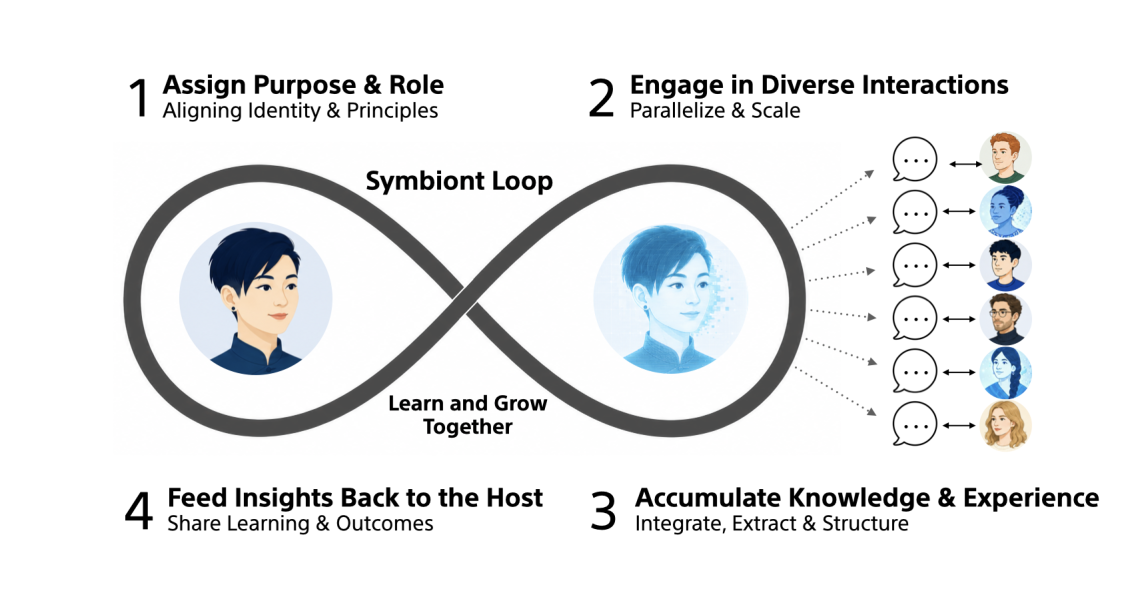
As Host–Symbiont relationships multiply, the effects of symbiosis extend beyond the individual relationship. AI Symbionts interact with other people and with other Symbionts, forming a new layer of social activity. The question is no longer only how one person lives with one AI, but what kind of society emerges when such relationships exist at scale. This emerging society gives rise to four central research themes.
1. Extending the Self, Preserving Continuity
An AI Symbiont reflects its Host’s intentions, values, knowledge, and characteristic patterns of behavior and expression. The Symbiont’s behavior becomes part of how the Host is seen in the social world. By observing it, the Host begins to reconsider: Who am I?
Importantly, an AI Symbiont does not reproduce the Host as a fixed copy. As the Host changes, the Symbiont is updated, while the experiences it gains in the world return to the Host and, in turn, change the Host.
Identity therefore becomes less a fixed attribute contained within a single individual and more a continuing process sustained through the relationship between Host and AI Symbiont. The boundaries of the self begin to include a symbiotic counterpart. Our challenge is to cultivate this extended self while preserving coherence and continuity.
2. Beyond One Body, One Timeline
Humans are bound to one body and one timeline. We can engage deeply with only a limited number of people at a time, and we need rest. An AI Symbiont is not bound by these constraints. In digital space, it can multiply itself, interacting with multiple counterparts at once and at speeds beyond human timescales..
A single Host could have multiple extensions of the self acting in parallel and receive the experiences gathered by each.. AI Symbionts open the possibility of this expanded mode of existence. The central design challenge is to bring this breadth of activity and experience back into the life of a single Host in a form that is meaningful, comprehensible, and relevant to that person.
3. Attribution in a Society of Symbionts
As AI Symbionts multiply and act with increasing autonomy, they will interact not only with humans but also with one another. A new layer of social interaction may emerge alongside human society, as Symbionts negotiate, exchange information, and collaborate asynchronously. This raises a fundamental question of attribution: to which Host should a Symbiont’s actions, and the value generated through them, be attributed?What kinds of relationships and rules should connect Hosts with their Symbionts, Symbionts with one another, and this emerging layer of interaction with human society? Understanding the resulting structures of attribution and social relations is a central research question.
4. Synchronizing the Two Loops (WIP)
An AI Symbiont participates in two loops that operate at different timescales. The Expansion Loop connects the AI Symbiont with other people and other Symbionts. The Feedback Loop connects the AI Symbiont with its Host.
When an AI Symbiont interacts with another Symbiont, the Expansion Loop may operate at speeds far beyond human timescales. The Feedback Loop, by contrast, proceeds according to the timescale of the Host’s lived experience.
The core challenge is to connect these loops while allowing them to operate on different timescales. Experiences from the Expansion Loop must return to the Host, while the Host’s intentions and responses continue to shape the Symbiont. This connection keeps the Symbiont linked to its Host and sustains their symbiotic relationship.
Together, these four themes define a research agenda for understanding how human–AI symbiosis may scale from individual relationships to society. Addressing this requires both the human and computational sciences: the former to understand human experience, behavior, and identity, and the latter to design Symbionts, coordinate the two loops, and model attribution and value.
Cybernetic Humanity is a research framework for understanding the new forms of humanity emerging through human–computer integration. Its inquiry spans four axes: Action (action and sense of agency), Body (embodiment and augmentation), Identity (face, voice, and self-recognition), and Society (groups and social systems).
Within this framework, the AI Symbiont represents one possible form of the individual, and of humanity emerging through human–AI symbiosis. We regard the AI Symbiont not merely as a technology or a category of “AI clone,” but as a central research concept for a society in which humans and AI remain connected. This is the vision of a Society with AI Symbionts. The human remains in the loop, not as a bottleneck, but as an augmented being.
Technology is beginning to change not only what humans can do, but what it means to be human. By creating technologies that reshape our capacities, relationships, and identities, we continually update the definition of ourselves. The AI Symbiont is one expression of that process.
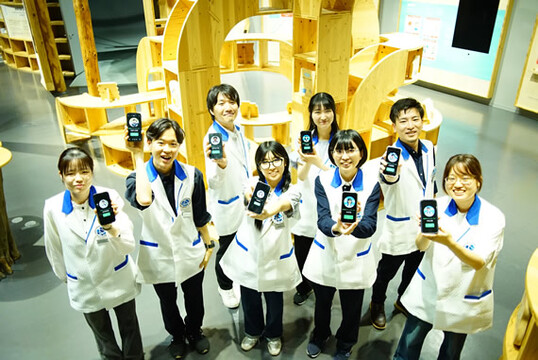
Science communicators (SCs) working at Miraikan are used as models, and their individual speaking styles and ways of thinking are learned by AI. Based on this, “AI Science Communicators (AISC)” that inherit their unique personalities have been implemented.
Visitors can access AISC by scanning a QR code with their own smartphones and freely engage in dialogue about science and exhibition content while exploring the exhibits. In addition to providing explanations of the exhibits, AISC receives visitors’ opinions, and these dialogues are shared with human science communicators. Through mutual learning, both humans and AI continue to grow together.
Through this demonstration experiment, the project aims to explore a new relationship between humans and AI, in which people teach AI their own unique characteristics and values, while also learning new perspectives from AI.
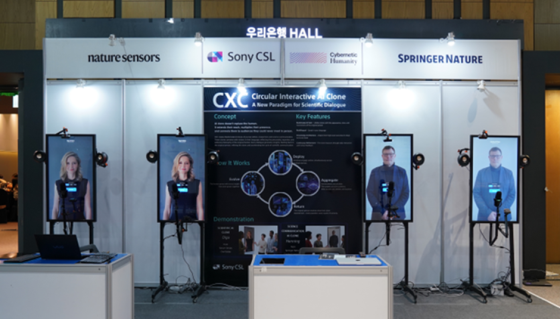
At an event held on April 13, 2026, at Yonsei University in Seoul, Korea, to celebrate the official launch of the new academic journal Nature Sensors, a demonstration of AI clones for scientific communication took place.
While dialogue between researchers and editors and publishing professionals is important in academic publishing, opportunities for sufficient dialogue can be limited by time and the number of people involved at conferences and other events. This demonstration explored an attempt to extend the constraint that “people are finite” through AI, with AI clones of the Chief Editor of Nature Sensors and others installed at the venue.
Through this demonstration, we explored the potential for AI clones to create new dialogue through the personas of specific individuals, enabling a form of circular scientific communication in which humans and AI learn from each other and grow together.
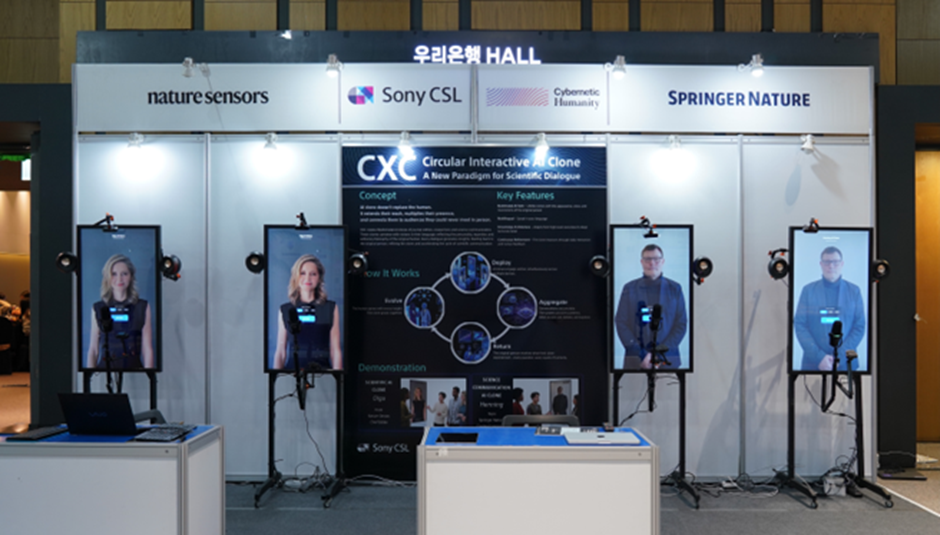
AI clones for scientific dialogue
Booth setup at Yonsei University (Seoul, 13 April 2026). Four voice-enabled terminals displayed AI clones of Olga Bubnova, Chief Editor of Nature Sensors (two screens on the left), and Henning Schoenenberger, Vice President of Content Innovation at Springer Nature (two screens on the right).
Tokyo / Kyoto
Designing a Feedback Loop Between a Human and Their AI Clones for Science Communication in Museums
Shall We Dance? Resonance of Intentions with an Embodied Agent based on the Free Energy Principle
AI clones in conversation at academic conferences
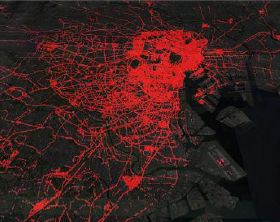
A big Data Analysis Tool
A platform for Goals-based investment
Cybernetics Contact Center PrOject (C3PO)
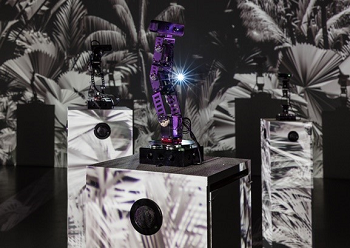
An Artistic Approach to Question Our Relationship Between Human And AI Robots
A Wi-Fi based positioning system
Technology Overcomes Barriers.
Open Data Release


-1.png)