Frequency Biology Project
Advancing Marine Environmental Observation through High-Speed Behavioral Analysis and Particle Sensing
Resources and energy are indispensable to human life. Land-based resources have been prioritized due to their accessibility to this day, but attention is increasingly turning toward the ocean, where abundant untapped resources exist. However, in remote regions such as the deep sea, our scientific understanding of how human activities affect ecosystems and carbon cycles is still limited, since observation is extremely difficult.
The deep sea is one of the most challenging environments on Earth to observe. As depth increases, water pressure rises steeply, requiring instruments and sensors to have highly robust structures. Water temperatures drop to 2–4°C, which substantially affects electronics and battery performance. Furthermore, both radio waves and light attenuate rapidly underwater, making terrestrial-style communication infrastructure completely unusable. Most deep-sea regions are in total darkness where sunlight does not reach, requiring artificial lighting for observation, which in turn increases power consumption and physical strain on equipment. Deep-sea surveys rely on specialized platforms such as remotely operated vehicles (ROVs), support vessels, and skilled crew members, all of which involve extremely high operational costs. Conducting comprehensive surveys over the vast ocean using these methods is realistically impossible. Poor sea conditions can even prevent vessels from departing, halting the observation process entirely. In this way, deep-sea observation presents uniquely formidable challenges, due to high pressure, low temperature, darkness, communication limitations, restricted access, high cost, and the need for long-term autonomous operation.
Introducing a New Behavioral Biology: “Frequency Biology”
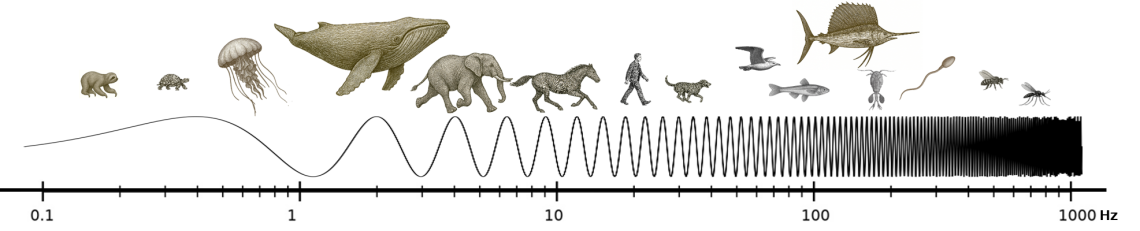
I hypothesized that even under harsh deep-sea conditions, environmental changes on the seafloor could be detected by tracking shifts in the behavior and biomass of plankton and benthic organisms—groups known to be highly sensitive to environmental variability—using advanced sensing technologies. When we observed plankton samples in an aquarium, I noticed that each species displayed distinct movement patterns. Micro-organisms such as plankton and insects operate at speeds far beyond human perception, repeating actions tens to hundreds of times per second. Although these rapid movements are invisible to the naked eye, combining AI with high-speed sensors makes millisecond-scale behavioral analysis possible.
This perspective on “the motion of micro-organisms” led me to propose a new concept in behavioral biology: Frequency Biology. It focuses on the frequency of repeated micro-scale movements, enabling us to extract characteristic behavioral patterns that conventional methods have overlooked. These behavioral frequencies are expected to become powerful indicators for evaluating changes in the marine environment with high precision.
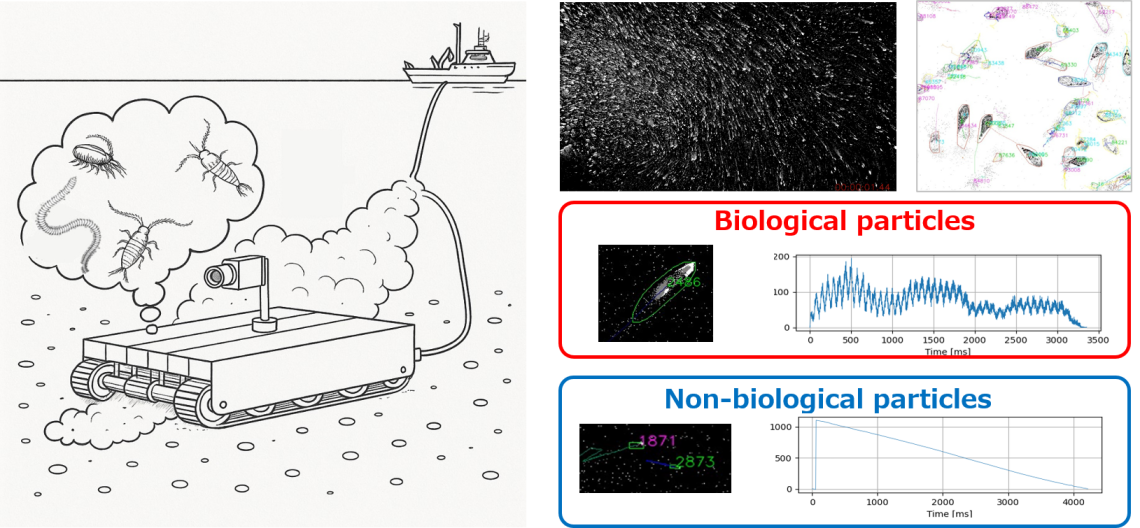
To achieve this, we adopted event-based vision sensors (EVS), allowing high-speed, high-sensitivity direct measurement of suspended marine particles. EVS outputs only pixel-level brightness changes asynchronously and captures the equivalent of 10,000 fps without frame synchronization. As a result, it provides the temporal resolution of a conventional high-speed camera while generating only 200 MB–1 GB of data per minute.
In ocean experiments, more than 5,000 particles were measured within a single minute. The system demonstrated capabilities not only in particle size distribution, flow velocity, and flow direction analysis, but also in biological particle classification and biomass estimation. Power consumption was reduced to less than one-tenth of conventional systems, making long-term autonomous observations feasible.
Under the framework of the International Seabed Authority (ISA), continuous environmental monitoring before, during, and after resource extraction is mandated, and this technology is expected to be utilized as a field-deployable monitoring solution capable of meeting these requirements.
Beyond Life: Following Micro-Particle Dynamics to Understand the Seafloor
Furthermore, this project tracks the dynamics of micro-particles across both biological and non-biological domains. One phenomenon of particular interest is the “plume.”
At seafloor resource development sites, anthropogenic plumes—clouds of fine particles—are generated during mining operations. As mining equipment stirs up seafloor sediments, these plumes are carried by ocean currents and dispersed into the surrounding environment. Observing such plumes on site provides core data for assessing the extent to which deep-sea mining affects the environment, including ecosystems.
Furthermore, measuring the characteristics of particles within a plume makes it possible to estimate the “timescale of impact,” such as how long the particles remain suspended. Advanced sensors capable of high-speed recording are essential for accurately capturing micro-particles drifting in ocean currents. The resulting measurement data not only contributes to the development of mining technologies that minimize environmental impact, but also serves as important reference data for establishing international standards for seafloor mining.
Expanding the Research
This research can be applied across a wide range of fields that require directly capturing the movement of particles and microscopic organisms in the ocean, including the analysis of fish larvae and feed plankton in aquaculture, as well as research on the carbon cycle mediated by marine snow.
The essential value of Frequency Biology lies in making the movements within the ocean—previously difficult to observe—directly visible at high speed and with a low observational burden through EVS. By measuring not only the concentration and abundance of particles and microscopic organisms, but also how they move, we aim to build a new observational foundation that contributes to a better understanding of the marine environment, safer industrial applications, environmental impact assessment, and the sustainable use of the ocean.
Members



Frequency Biology PJ.
Project Engineer