Advancing Medicine with Palm-Sized Robots
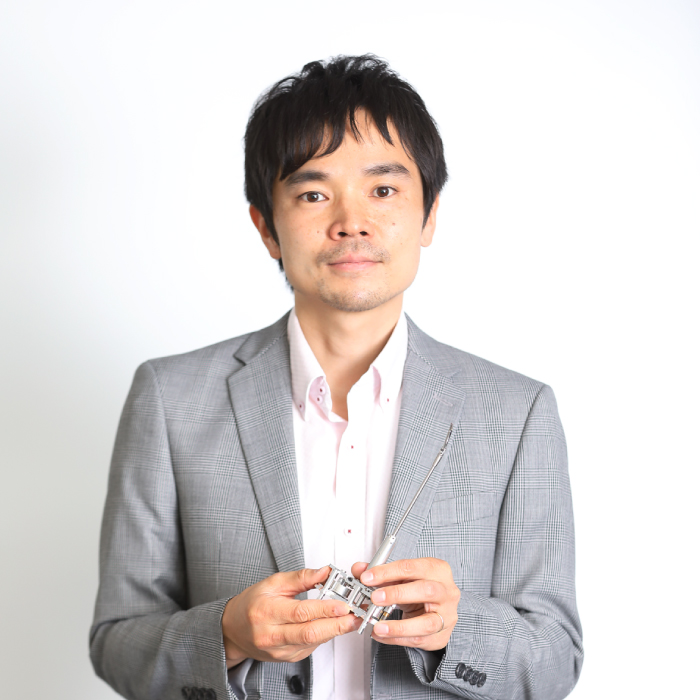
The ultimate goal of my research is to develop compact, precise and affordable robots that can extend beyond the capabilities of the human hand, and thereby contribute to advances in medicine.
Our current work focuses on regenerative medicine in ophthalmology, a field that requires extremely delicate and precise manipulation. We are developing compact, high-precision, and low-cost surgical robots based on origami-inspired robotic technologies, along with precision force-sensing technologies used for their control and validation.
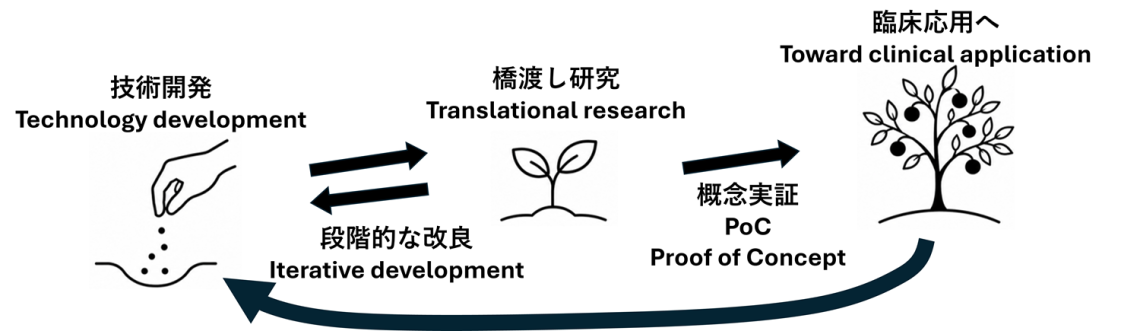
Our research encompasses not only the development of new technologies but also the evaluation of their value as medical devices. We collaborate with medical experts to establish frameworks for risk-benefit assessment. Our approach follows a continuous research and development cycle: first, developing a new technology; next, evaluating its medical value; and then, applying those findings to subsequent technology development. By sustaining this cycle, we aim to pursue research that contributes to advances in medicine.
Technologies to Treat Disease
As a child, I was fascinated by novel technologies invented by talented engineers. I would cut out advertisements from consumer electronics store flyers and create my own benchmarking tables of new products. To me, the late Masaru Ibuka, co-founder of Sony, and the late Soichiro Honda, founder of Honda were like wizards—engineers I admired for their ability to continually invent new technologies. What I learned from them was that technology is not merely a feature of a product, but something with the power to fundamentally change society and people’s lives. That belief continues to shape my research today.
As a university student, I began to think about how the robotics technologies that I was passionate about could be used to help people. This led me to develop an interest in medical and assistive robotics. A turning point came during my third year at university, when a conversation with a young researcher then at the MIT Media Lab made me realize the profound value of developing technologies that can actually treat disease.
If technology can help treat a disease, the resulting treatment can change not only a person’s physical functions and ability to live independently, but also the course of that person’s life. The impact can extend far beyond the patient, reaching their family members, friends, colleagues, and others they encounter through work and social life. I came to believe that technologies that contribute to medicine can therefore have substantial social value.
This conviction grew even stronger after the passing of Dr. Kenichiro Nagasaka, who was my supervisor, mentor, and a major influence on my robotics research. Experiencing the death of someone I had spoken with as recently as the day before made me acutely aware that, despite the remarkable advances in medicine, there are still limits to what modern medicine can do. Researchers and medical professionals around the world continue to work tirelessly to overcome these challenges, yet many diseases still lack sufficiently effective treatments. I would like to use the robotics expertise I have developed to contribute, even in a small way, to overcoming such diseases. For me, this is what “paying it forward” means, and it is the driving motivation behind my research at Sony CSL today.
The Value and Limitations of Surgical Robots
Looking back at the history of medical innovations, technologies such as X-ray imaging, MRI, CT, and catheters have significantly expanded the possibilities of diagnosis and treatment. Surgical robotic systems are another example.
The human hand is remarkably dexterous, but it is impossible to completely eliminate physiological hand tremor, and there are limits to how precisely we can manipulate objects too small to be seen with the naked eye. If robot-assisted manipulation can overcome these limitations, it may enable treatments that were previously difficult to perform and improve the reproducibility of surgical procedures. Furthermore, less invasive surgery could lead to shorter hospital stays and an earlier return to everyday life.
One of the best-known examples of surgical robotic systems is the da Vinci system developed by Intuitive Surgical, which received U.S. FDA approval in the early 2000s and is now widely used around the world. Yet the concept of robotic assistance in surgery is actually much older. An issue of Weekly Shonen Sunday published in September 1969 featured an illustration imagining a future operating room that captured many of the features of today’s surgical robotic systems. The illustration has also been introduced in a paper by Dr. Kazuhiro Hongo [1]. Perhaps children more than half a century ago were already dreaming of a future in which such advanced surgery would become commonplace.
At the same time, these sophisticated robotic surgical systems have primarily been introduced at large medical institutions, such as university hospitals, with spacious operating rooms and sufficient human resources. Their broader adoption remains challenging because of limitations related to their current design and the high cost of installation. Many surgical robots today are large, with some equipped with robotic arms approximately two meters long, creating a potential risk of physical interference with patients or other surgical instruments during surgery. These robotic systems can also cost hundreds of millions of yen to install, in addition to substantial costs for consumables.
To bring these technologies to a wider range of medical settings, including smaller clinics with limited operating-room space, and ultimately to more patients, simply making existing robots smaller is not enough. I believe we need fundamentally different approaches to design and manufacturing that can achieve dramatic reductions in size, while simultaneously improving precision and lowering cost.
What Becomes Possible with a Palm-Sized Robot
To make robots significantly smaller, more precise, and less expensive, it is important to greatly simplify their mechanisms and use materials that are as readily available as possible.
Many conventional robots are built from machined metal links combined with joints that use bearings and shafts. However, machining metal components is generally expensive. Mechanical elements such as bearings also have inherent limits to how small they can become, while mechanical clearances—the small gaps required within a structure—can make it difficult to achieve higher precision.
Robots inspired by origami structures (“origami-inspired robots”) offer a different approach. These robots can be built with simple mechanisms using commonly available plastic materials, significantly reducing the number of components while also making it easier to minimize mechanical clearances.
Origami-inspired robotic technologies have been actively studied, particularly for applications such as insect-like robots and small drones [2].
Around 2017, I began exploring the idea of applying this technology to surgical assistance, with the goal of creating a simple, palm-sized surgical robot. After approximately one year of development, we presented an origami-inspired robot for microsurgery in 2020, based on a Remote Center of Motion (RCM) mechanism widely used in minimally invasive surgical robots [3].
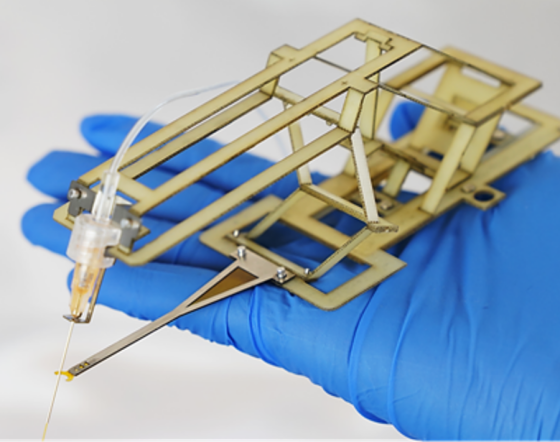
After joining Sony CSL in 2021, we launched collaborative research with experts in regenerative medicine to develop Origanoid, a more practical origami-inspired surgical manipulator designed to assist retinal reconstruction involving subretinal injection [4].
Origanoid can manipulate surgical instruments with approximately 10 μm precision and is compatible with the sterilization required for surgical devices. This robot’s simple, palm-sized structure, based on commonly available plastics, also makes it possible to fabricate each robot for approximately 4,000 yen in material costs (as of 2024). In 2026, through our collaborative research, we demonstrated that Origanoid could perform multiple subretinal injections in an animal model [5]. (Press release, August 25, 2026)
These studies are still at an early stage, focused on developing prototypes and demonstrating feasibility. However, our goal goes beyond reporting these results in academic papers. I hope to see these technologies eventually used in actual clinical settings.
If such palm-sized robots become widely available, they could help create a future in which advanced treatments are accessible not only at major hospitals, but also at hospitals serving local communities and smaller medical institutions around the world. I hope that our research will be one step toward making that future possible.
Researching Risk-Benefit Assessment for Medical Devices
Risk-benefit assessment is an important concept for evaluating the value of medical products and is widely used in regulatory decision-making, including regulatory approval and reimbursement decisions around the world. For pharmaceuticals and medical devices, it is necessary to weigh the benefits of treatment against risks such as side effects and intraoperative adverse events and evaluate their overall value.
Surgical robotic systems are no exception. After entering clinical use, these systems are commonly evaluated through clinical studies such as large-scale randomized controlled trials to assess their efficacy and safety in comparison with open or endoscopic surgery [6].
However, specific challenges in conducting clinical risk-benefit assessments of medical devices have been reported [7]. For example, it’s necessary to consider not only risks arising from device malfunctions or performance limitations but also operational risks, including adverse events caused by user error and contamination of the device or surgical field. Through systematic analyses of previously published studies, we have found that numerous adverse events and near-miss events related to such operational issues have been reported for surgical-assistance devices, including surgical robotic systems [8], [9] and intraoperative imaging systems [10].
Evaluating these safety risks from the early stages of device development is important for bringing new medical devices to patients as rapidly and safely as possible. However, this also presents a difficult problem.
To adequately assess the efficacy and safety of a medical device, comparative studies involving many patients are generally required. Yet conducting such studies requires the device to already be in widespread clinical use. At the same time, widespread adoption requires sufficient clinical evidence. In other words, we face something of a “chicken-and-egg problem”: without adoption, it is difficult to gather data, but without data, it is difficult to achieve adoption.
The IDEAL Collaboration, which works to establish systematic methods for evaluating medical devices and new surgical techniques, recommends accumulating evidence on efficacy and safety before clinical use, through approaches such as animal studies and simulations [11] . However, for complex medical devices such as surgical robotic systems, there is still no sufficiently established methodology for determining what should be evaluated, to what extent, and how, during the early stages of device development [12].
Therefore, I believe that developing methodologies for the risk-benefit assessment of surgical robotic systems in the early stages of development is itself an important research topic.
For example, in subretinal injection studies using living animal models, the number of trials is limited. As a result, variability between animals and differences in surgeon skill can have a substantial impact on the results, making it difficult to ensure sufficient reproducibility. Furthermore, it is challenging to quantify small adverse events, such as retinal hemorrhage, and objectively compare them across different procedures.
Therefore, we are exploring new precise sensing technologies capable of measuring the contact force applied to the tip of a surgical needle. By objectively comparing conventional manual injections with robot-assisted injections, these technologies may enable more objective and reproducible risk-benefit assessments, even under limited experimental conditions.
From Foundational Research to What Comes Next
Moving forward, I would like to continue developing new technologies, evaluating their risks and benefits, and feeding the results back into subsequent technology development. By repeating this cycle, I hope to bring these technologies into clinical use as soon as possible.
At the same time, I would like to explore new applications where palm-sized, high-precision, and low-cost robots can offer unique value.
One example is the manipulation of organoids or cells in life sciences. Many delicate tasks such as cutting, moving, and combining fragile tissues are still performed by hand. If robots could carry out these manipulations with high precision and reproducibility, they could improve the success rate and reproducibility of experiments. I believe that such robot-assisted manipulations could potentially lead to scientific discoveries that have previously been difficult to make.
And discoveries emerging from such basic research could eventually lead to new treatments and medical technologies that reach clinical practice and drive further advances in medicine.
I would like to develop palm-sized robots not simply as surgical robotic systems, but as technologies that bridge life sciences—the foundation of medicine—and clinical practice.
Toward a world in which everyone, wherever they are, can access advanced medical care, I will continue developing palm-sized robots that help bridge the gap between fundamental research and clinical practice.
[1] K. Hongo, “脳神経外科手術機器開発におけるイノベーション,” Jpn. J. Neurosurg., vol. 30, no. 7, pp. 527–529, 2021. http://dx.doi.org/10.7887/jcns.30.527
[2] S. Felton, “Origami for the everyday,” Nature Machine Intelligence, vol. 1, no. 12, pp. 555–556, 2019.
[3] H. Suzuki and R. J. Wood, “Origami-inspired miniature manipulator for teleoperated microsurgery,” Nat. Mach. Intell., 2020.
[4] H. Suzuki, “A Miniature 1R1T Precision Manipulator with Remote Center of Motion for Minimally Invasive Surgery,” Proceedings of the 2024 IEEE International Conference on Robotics and Automation (ICRA), May 2024.
[5] H. Suzuki, Y. Nakano, Y. Koyama, T. Maeda, and M. Takahashi, “Origami-inspired manipulator enables in vivo subretinal injection,” Npj Robot., vol. 4, no. 1, June 2026.
[6] H. F. Roh, S. H. Nam, and J. M. Kim, “Robot-assisted laparoscopic surgery versus conventional laparoscopic surgery in randomized controlled trials: A systematic review and meta-analysis,” PLoS One, vol. 13, no. 1, p. e0191628, Jan. 2018.
[7] E. A. M. Neugebauer et al., “Specific barriers to the conduct of randomised clinical trials on medical devices,” Trials, vol. 18, no. 1, p. 427, Sept. 2017.
[8] H. Suzuki, K. Hattori, and K. Iwasaki, “An Investigation of Post-market Early-Stage Research Designs Between Two Generations of da Vinci and Versius: Focus on Prospective Studies and Adverse Event Analysis,” Regulatory Science of Medical Products, vol. 15, no. 2, May 2025.
[9] H. Suzuki, K. Hattori, and K. Iwasaki, “Time-Series and Thematic Analyses of Clinical Utilities and Operational Issues in Early Clinical Studies of the da Vinci Surgical System,” Journal of Robotic Surgery, vol. 20, no. 1, May 2026.
[10] H. Suzuki, Y. Tsuboko, M. Tamura, K. Masamune, and K. Iwasaki, “Synthesis of the clinical utilities and issues of intraoperative imaging devices in clinical reports: a systematic review and thematic synthesis,” BMC Med. Inform. Decis. Mak., vol. 25, no. 1, p. 70, Feb. 2025.
[11] P. McCulloch et al., “No surgical innovation without evaluation: the IDEAL recommendations,” Lancet, vol. 374, no. 9695, pp. 1105–1112, Sept. 2009.
[12] H. J. Marcus et al., “The IDEAL framework for surgical robotics: development, comparative evaluation and long-term monitoring,” Nat. Med., vol. 30, no. 1, pp. 61–75, Jan. 2024.
Keywords
Other projects in the same research area
Human Augmentation
A Wi-Fi based positioning system


an update on Superception - a research framework