Alexis André
Paris
“Tomonami” was conceived by researcher Alexis André from his work on creativity acceleration.
While exploring ways to enhance artist’s creativity, Alexis André hypothesized that creativity could be explained by two elements. One is the ability to generate new ideas, and the other is the ability to evaluate them. Tomonami was developed with the insight that technology could accelerate the cultivation of these abilities of artists.
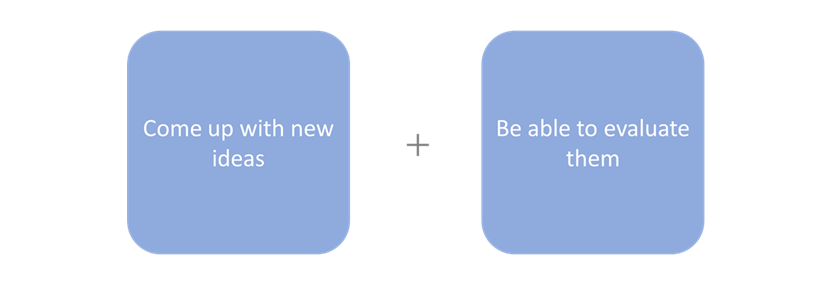 Being creative is the combination of two skills.
The first creations of art using Tomonami begin with researcher Alexis André tapping his own experience as an artist while gaining an understanding of creativity through dialog with an artist. Characteristic features of an artist’s expression are uniquely extracted from the artist’s past work, and then reflected in the form of parameters in the user interface of originally developed software, to provide a space for the artist to explore their creativity.
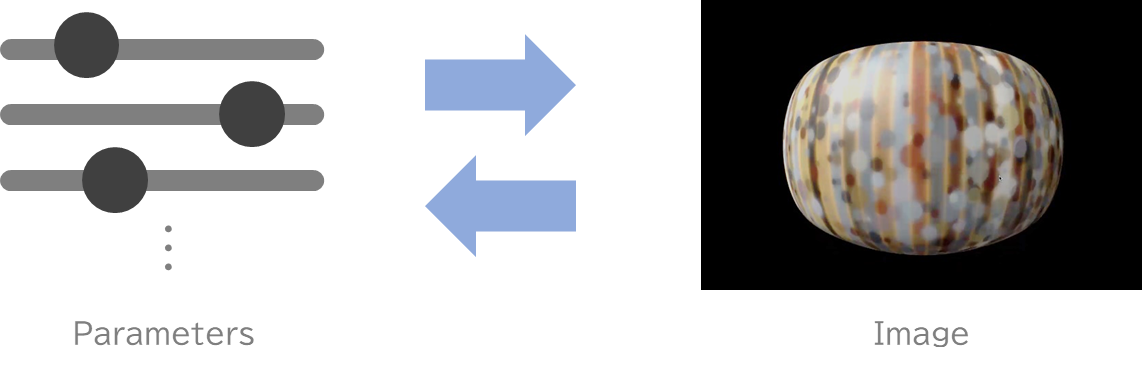
The artist explores this space by manipulating the parameters. The artist can use Tomonami to generate ideas in a short period of time (creating choices autonomously), and then use the artist’s own artistic sensibilities and taste to evaluate them and determine whether or not to adopt them. This acceleration of the trial-and-error cycle of the creative process is the core of Tomonami, and leads to new creations that the artists themselves could not have imagined.
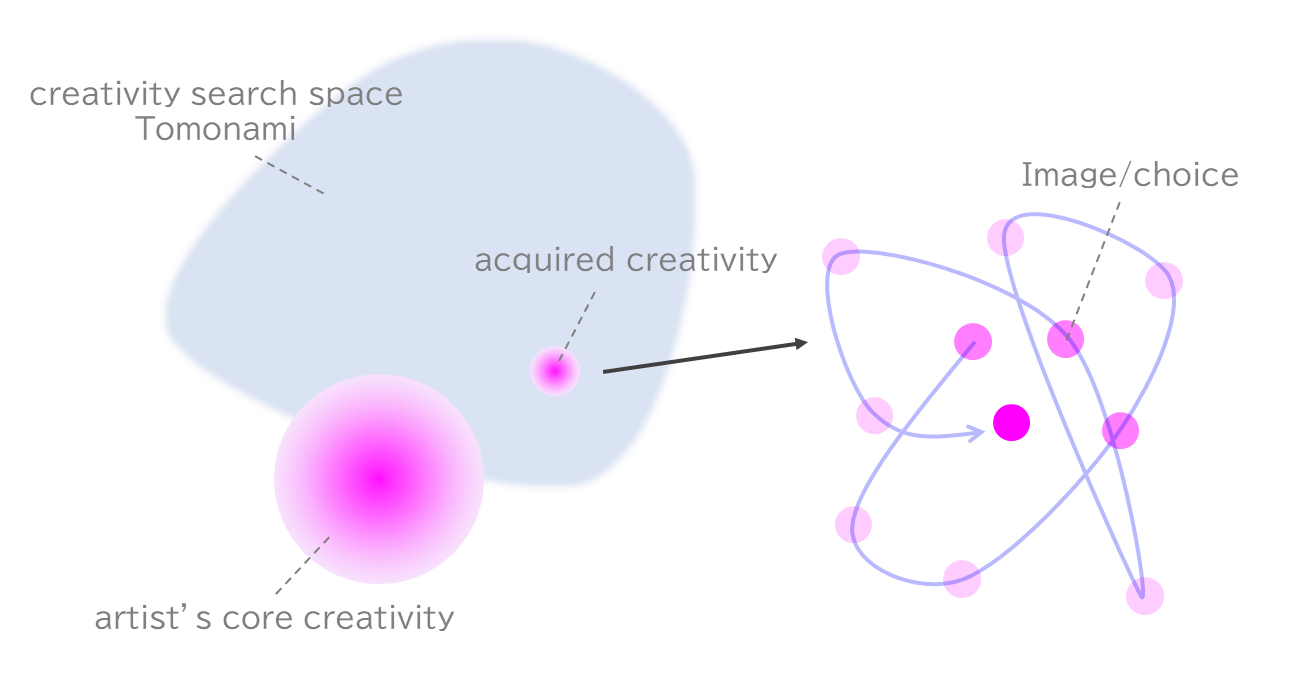
Through Tomonami, Alexis André aims for artists to acquire new creativity that forms the foundation for the creation of novel artworks.
Tomonami has been developed and deployed through collaboration with creators working across different disciplines.
Below, we introduce examples of projects that have been undertaken to date.
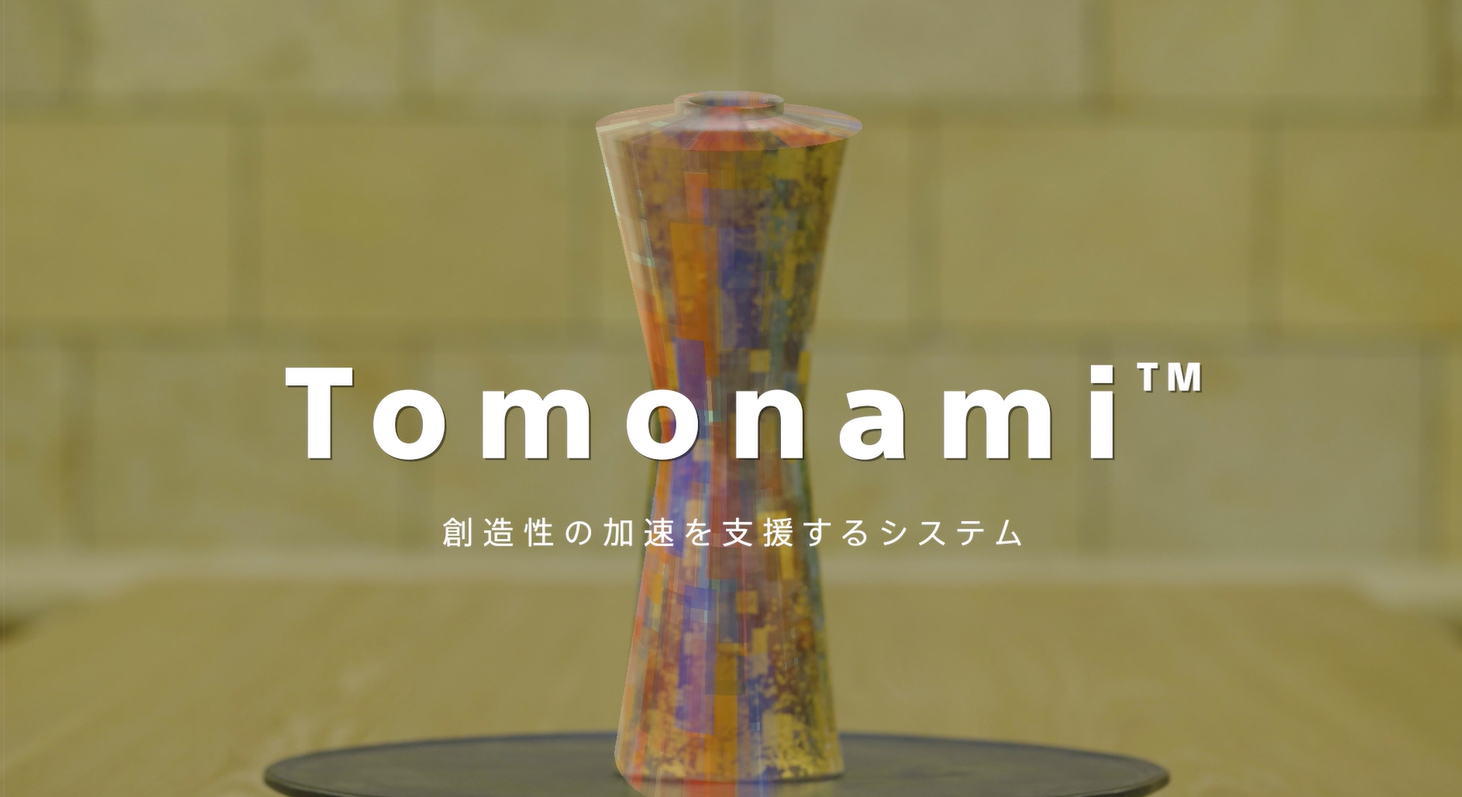
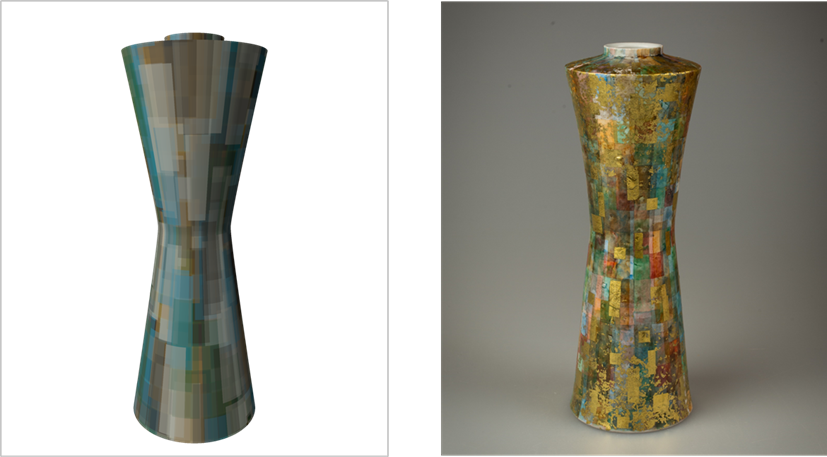
Currently, Alexis André is collaborating with Kutani-yaki, traditional Japanese porcelain, artist Yukio Yoshita, working on artwork production using the specially developed system “Tomonami for Yoshita Yukio.” (2023年11月 Press Release)
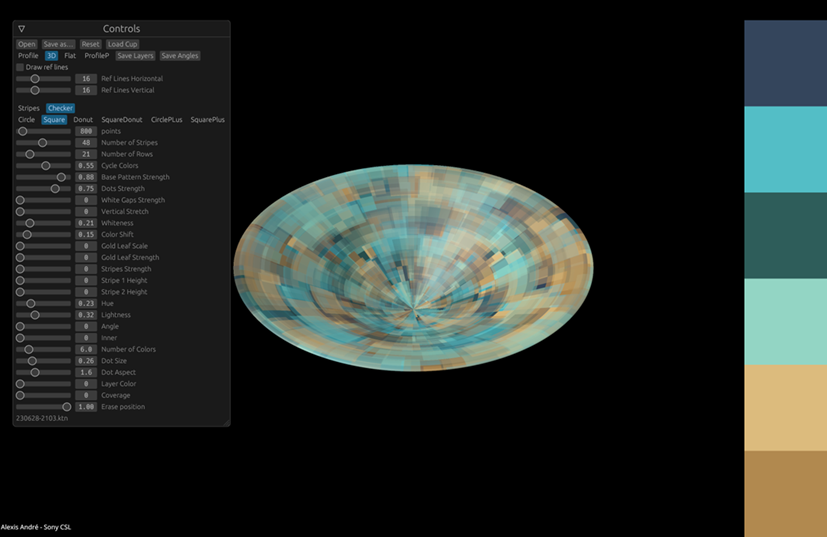
Tomonami does not have the intricate adjustment flexibility found in commercial design tools. This stems from the philosophy that Tomonami is fundamentally intended to support the creative process and is not a tool for design. Therefore, the generated images do not take into account constraints in the production process.
This is reflected in the actual creative process of Mr. Yukio Yoshita and is also evident in the following comment:
“I knew that the images presented by ‘Tomonami’ could not be directly incorporated into my work. While being pushed by Tomonami, I was actually seeing different images in my head from the generated images by weaving in interpretations based on my previous experiences”.
Currently, Yuzen artist Ken Yotsui is working on artwork production using the specially developed system “Tomonami for Ken Yotsui.”
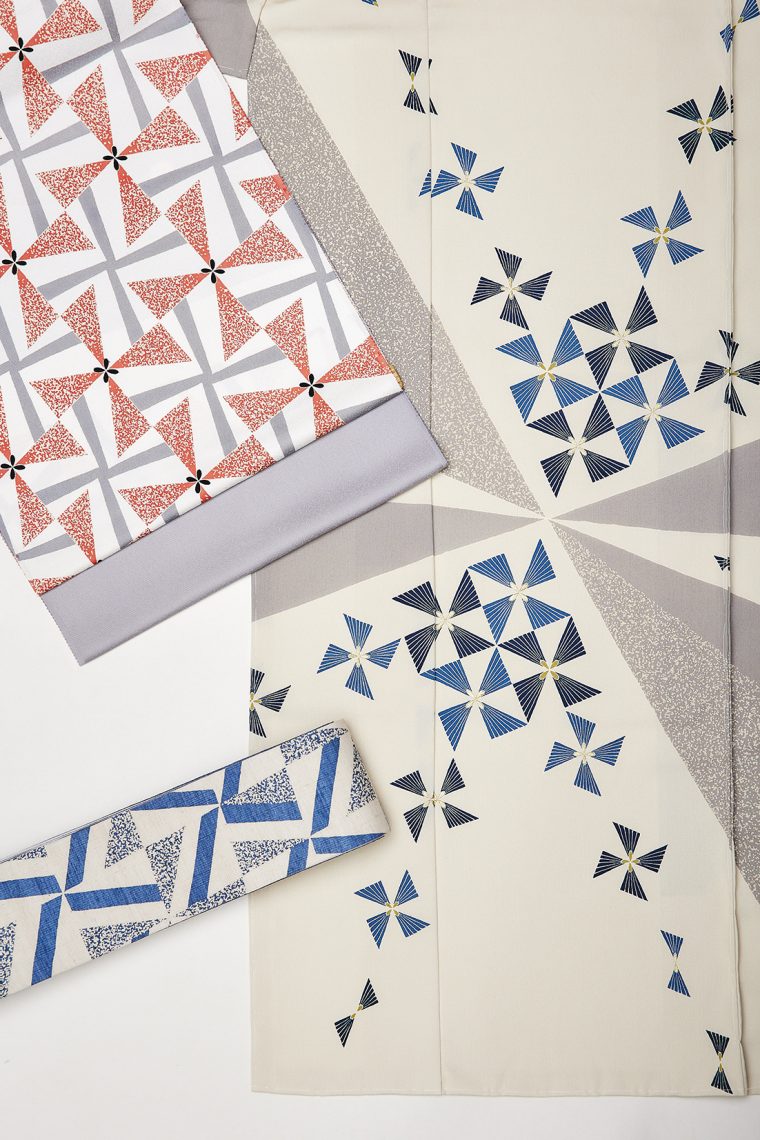
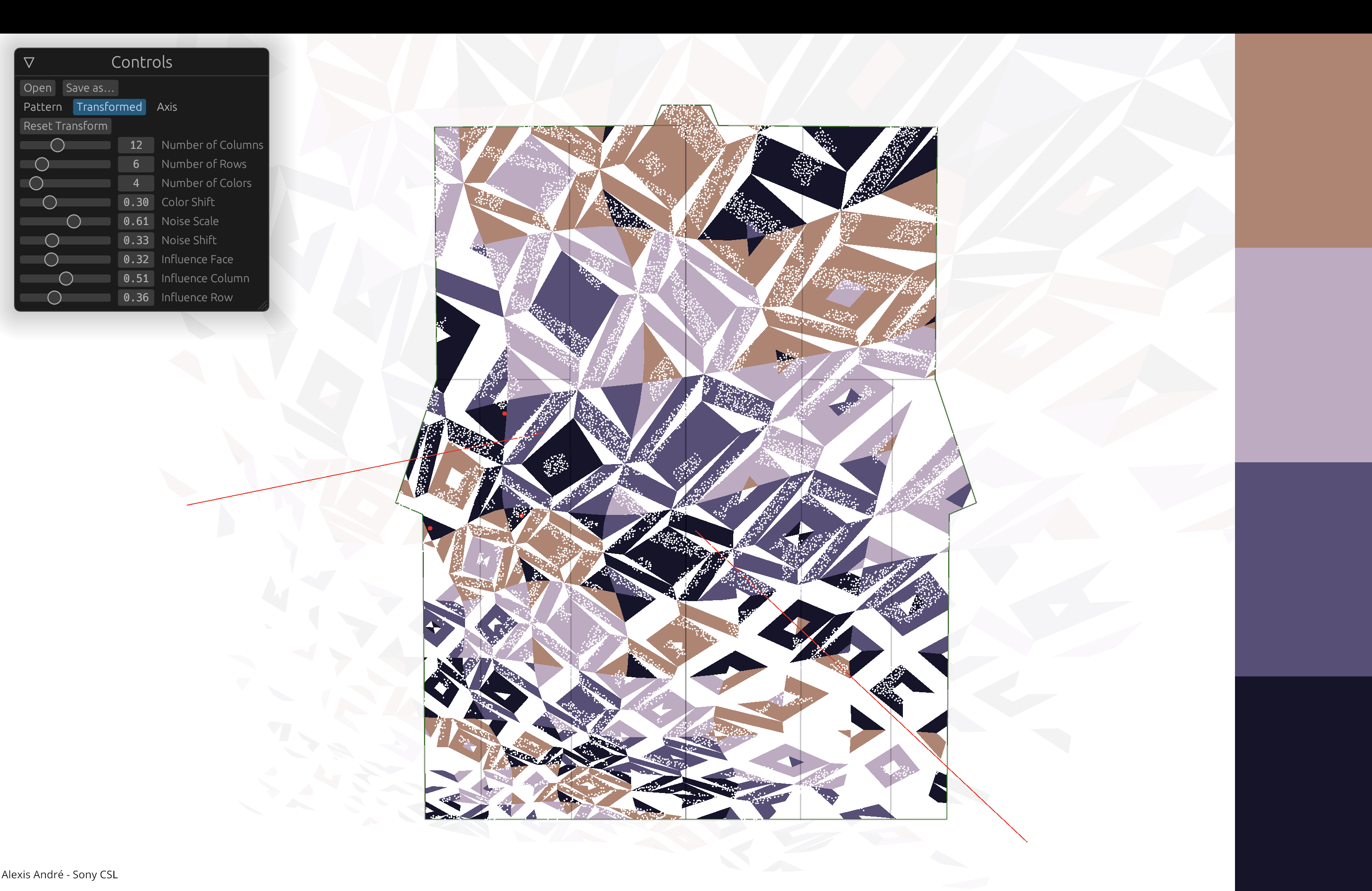
Work created using Tomonami / The Tomonami operating screen
At his solo exhibition held at Ginza Motoji in January 2024, Tomonami further accelerated Yotsui’s exploration of how to reconcile the continuity of patterns required for garments to be worn beautifully with the continuity constraints inherent in the production process. The exhibition presented works that embody newly identified possibilities for expression revealed through this process.
(Press release, January 2024)
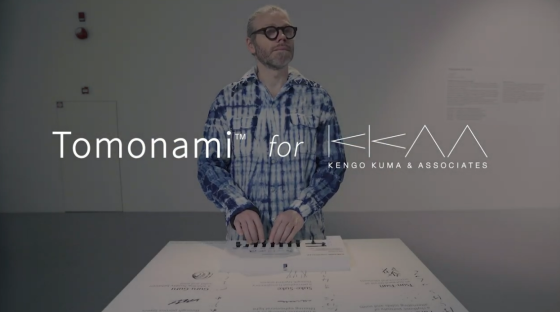
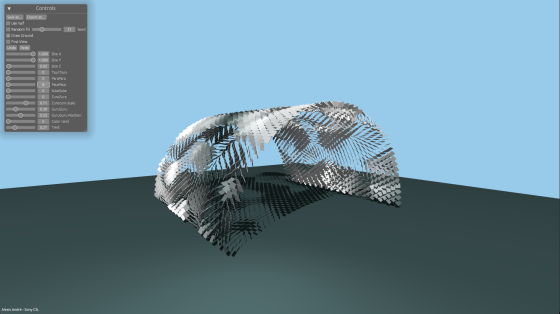
Alexis André is collaborating with Kengo Kuma and Associates (KKAA) on a joint exploratory project using “Tomonami for KKAA” (press release, January 2026).
To date, he has built unique systems that provide value while working closely with individual artists, including ceramic artist Yukio Yoshita and yuzen artist Ken Yotsui. This third project focused on dialogue among multiple creators in an attempt to accelerate creativity in a new field: architecture.
At KKAA, architects use Japanese onomatopoeic expressions for particle size, flow, texture, and other architectural elements from the initial design stage, and share them among themselves to create works.
With Tomonami for KKAA, Alexis André incorporated this onomatopoeia as parameters into the user interface of his original framework, which provides KKAA’s architects with an exploratory space for creativity.
In developing the design, the architects explore this space by manipulating the parameters. By using Tomonami, the architects can generate ideas in a short period of time while repeating the process of exploring options autonomously and then using their artistic sensibilities and taste to determine whether or not to adopt them. This process that accelerates the cycle of trial and error in the creative process is the core of Tomonami, leading to new creations that the creators themselves could not have imagined.
Furthermore, Tomonami for KKAA also supports dialogue that draws out the diversity of creativity unique to a group of architects by converting design intentions—which are often intuitive and ambiguous in conventional communication—into a shareable visual format.
Paris
Exhibits works at Kengo Kuma Exhibition
[INFO]Tomonami was conceived by researcher Alexis André from his work on creativity acceleration
“Worth preserving for the 22nd century” by Nobuyuki ‘Nobi’ Hayashi
"If you want to accomplish in your life, one thing that would contribute to the future of humanity - what is that?" How do researchers at Sony CSL reflect on these questions and engage with their own research? And what kind of place is Sony Computer Science Laboratories, shaped by such individuals? Through the words of the researchers themselves, we hope to share part of that perspective.
DC-based autonomous Microgrid for community